#ProjectManagement #KnowledgeContinuity #ERP
Team onboarding situation on project
On large-scale projects, it is important to find the right balance between staying within budget and maintaining team resilience — meaning having backup consultants for all key functional streams. I’d like to share some real project experience and lessons learned the hard way.
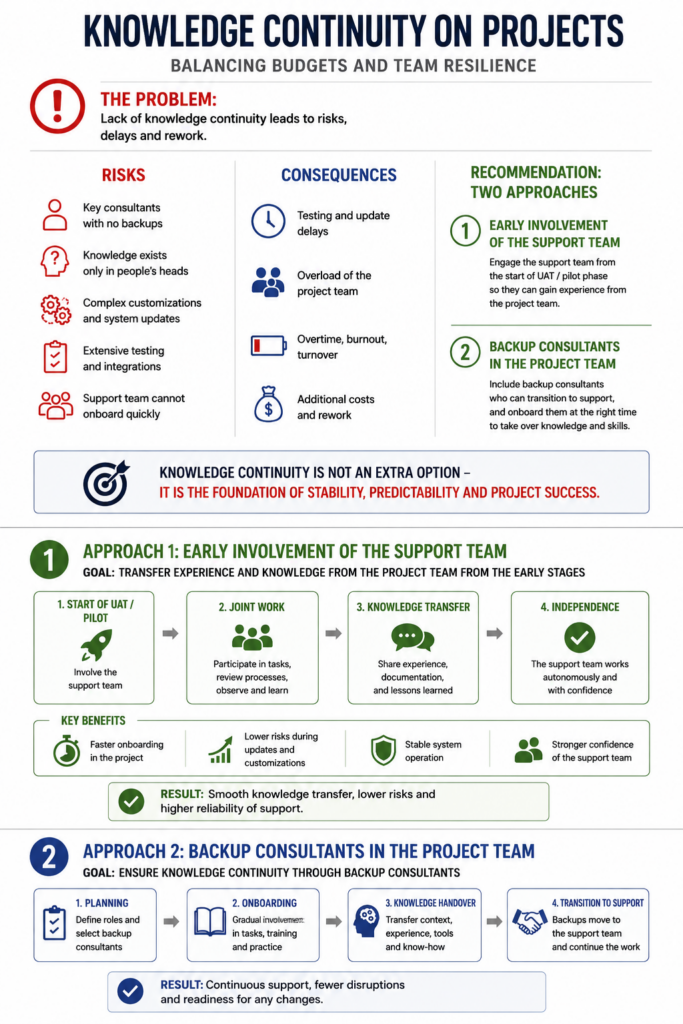
On one of the projects where I worked as a Functional Architect, the project manager and I did not pay enough attention to knowledge continuity. We had lead consultants who independently managed their functional areas very effectively. At the same time, documentation was properly maintained, project stages were formally closed, and the customer received the expected business value. Everything seemed fine.
However, after the user acceptance and pilot operation phase, the system was moved into production, and it became time to hand it over to the support team. Here it is important to mention a specific characteristic of this project: the scale and complexity of customizations were significant. In addition, immediately after go-live, the system had to undergo a major update, which required a large amount of module testing and integration interface testing.
As a result, despite the availability of project documentation that generally met company standards, the support team was unable to onboard quickly enough. We had to involve members of the project team — who had already been assigned to new projects — back into testing activities. Which, as you can imagine, led to overtime, burnout, and all the related consequences.
Conclusion / recommendation
There are two practical ways to mitigate these risks.
1. Involve the support team early — for example, starting from the pilot operation phase — so they can gain hands-on experience directly from the project team.
2. Build the project team with backup consultants who are prepared to transition into support roles later, and gradually onboard them at the stage when knowledge transfer can happen effectively and with proper context.